What is the difference between an erhu and a morin khuur?
They both have two strings and a bow. But one is not simply the Mongolian version of the other.
QUESTION FROM A READERAsked by an anonymous reader
GOT 30 SECONDS?
The short answer
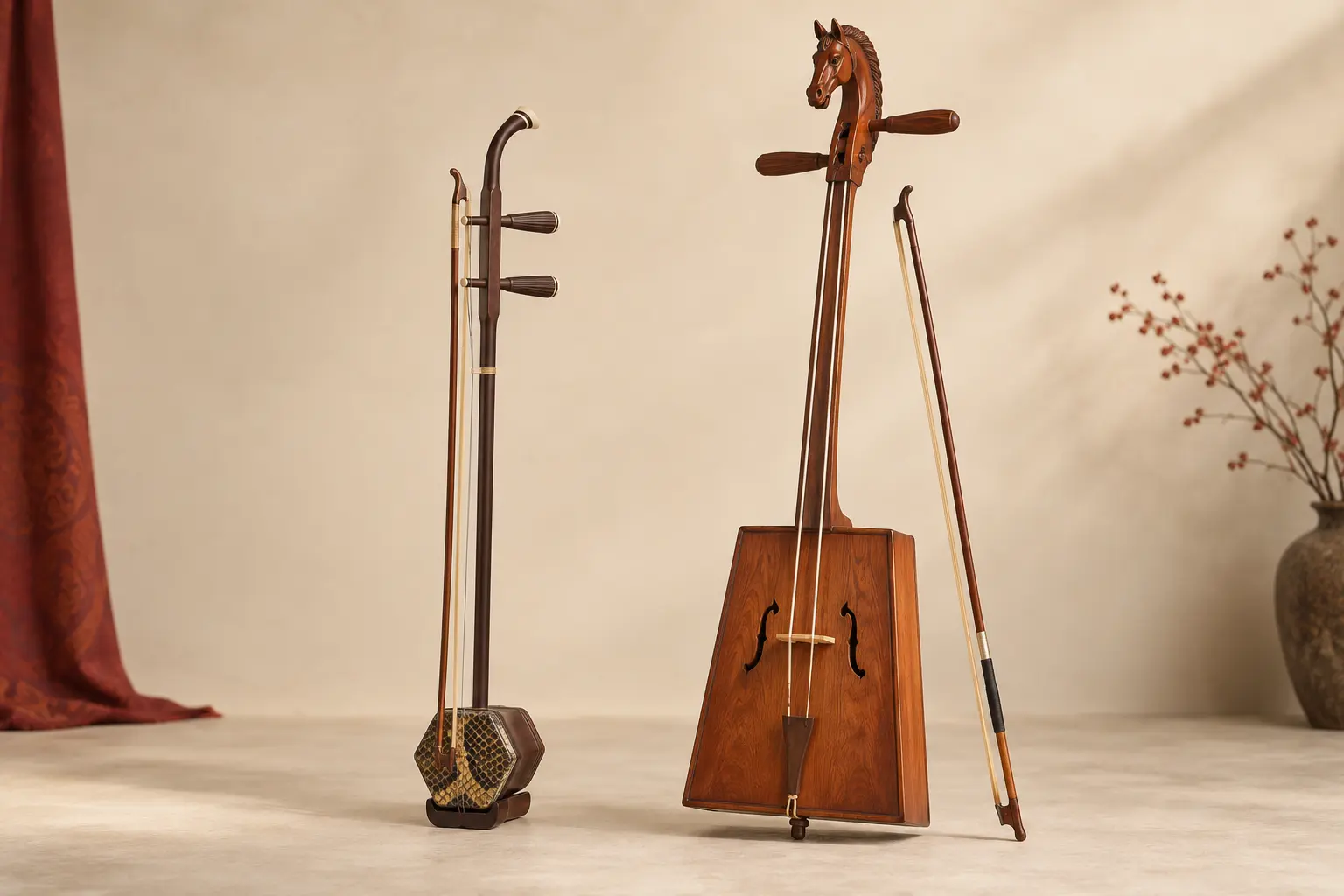
The Chinese erhu and Mongolia’s morin khuur are related bowed instruments, but they are not the same. The erhu has a small snakeskin-covered resonator and a bow trapped between its two strings. The morin khuur—often called the horsehead fiddle—is larger, has a trapezoidal wooden body, a carved horse head and a separate bow. Their sounds, playing techniques and cultural lives are distinctly their own.
First: it is not actually called a “Mongolian erhu”
The resemblance is real: both instruments are held upright, have two strings and are played with a bow. That makes “Mongolian erhu” an understandable description when someone sees one for the first time.
But the Mongolian instrument is the morin khuur, meaning horsehead fiddle. It has its own construction, technique and history. Calling it an erhu from Mongolia is rather like calling a cello a large Italian violin: convenient at a glance, but it misses what the instrument actually is.
The five-second visual test
Look first at the body. An erhu has a tiny hexagonal or cylindrical soundbox, traditionally covered on one face with python skin. Its neck is long and slender, and the whole instrument looks remarkably light.
A morin khuur has a much larger trapezoidal wooden soundbox. Its neck traditionally ends in a carved horse head—the clue that gives the instrument its English nickname.
The bows work differently
On an erhu, the bow hair passes between the two strings. The bow is effectively captive: the player pushes the hair against one string or pulls it against the other.
The morin khuur uses a separate bow that meets the strings from the outside. That difference changes the player’s hand movements, pressure and attack. A skilled erhu player would recognise some familiar ideas, but could not simply pick up a morin khuur and play it in exactly the same way.
Why do they sound so different?
The erhu’s small skin-covered resonator and relatively fine strings create a focused, bright and intensely vocal sound. It can sigh, cry and glide between notes, which is why people so often compare it with the human voice.
The morin khuur’s larger wooden body and thicker strings produce a deeper, breathier and earthier sound. Traditional strings and bow hair were made from horsehair, although modern instruments may use synthetic materials. Players can evoke long, open tones and the rhythm or call of a horse.
Each instrument carries a different world
The erhu is heard in Chinese folk music, opera, solo performance, film music and the modern Chinese orchestra. It became one of the most recognisable voices in Chinese music.
The morin khuur is a national symbol of Mongolia and deeply connected with nomadic life and horse culture. UNESCO recognises its traditional music as intangible cultural heritage. It accompanies long song and appears in ceremonies, celebrations and everyday musical life.
So are they related?
Yes, broadly. Both belong to the great family of bowed spike fiddles that travelled and evolved across Asia. Their shared two-string, upright form makes them look like cousins.
But “cousins” is the useful word—not twins, and not merely Chinese and Mongolian editions of one instrument. The fastest way to remember the difference is this: small snakeskin box and inside bow means erhu; horsehead, big wooden box and separate bow means morin khuur.
TAKE THIS WITH YOU
An erhu and a morin khuur are two-stringed cousins, not regional versions of one instrument: one is built around a small snakeskin resonator and an inside bow; the other around a horsehead, a larger wooden body and Mongolia’s horse culture.
Sources
Used to check the facts in this story.
 Photo: Hannliving